By Charlie Allenson
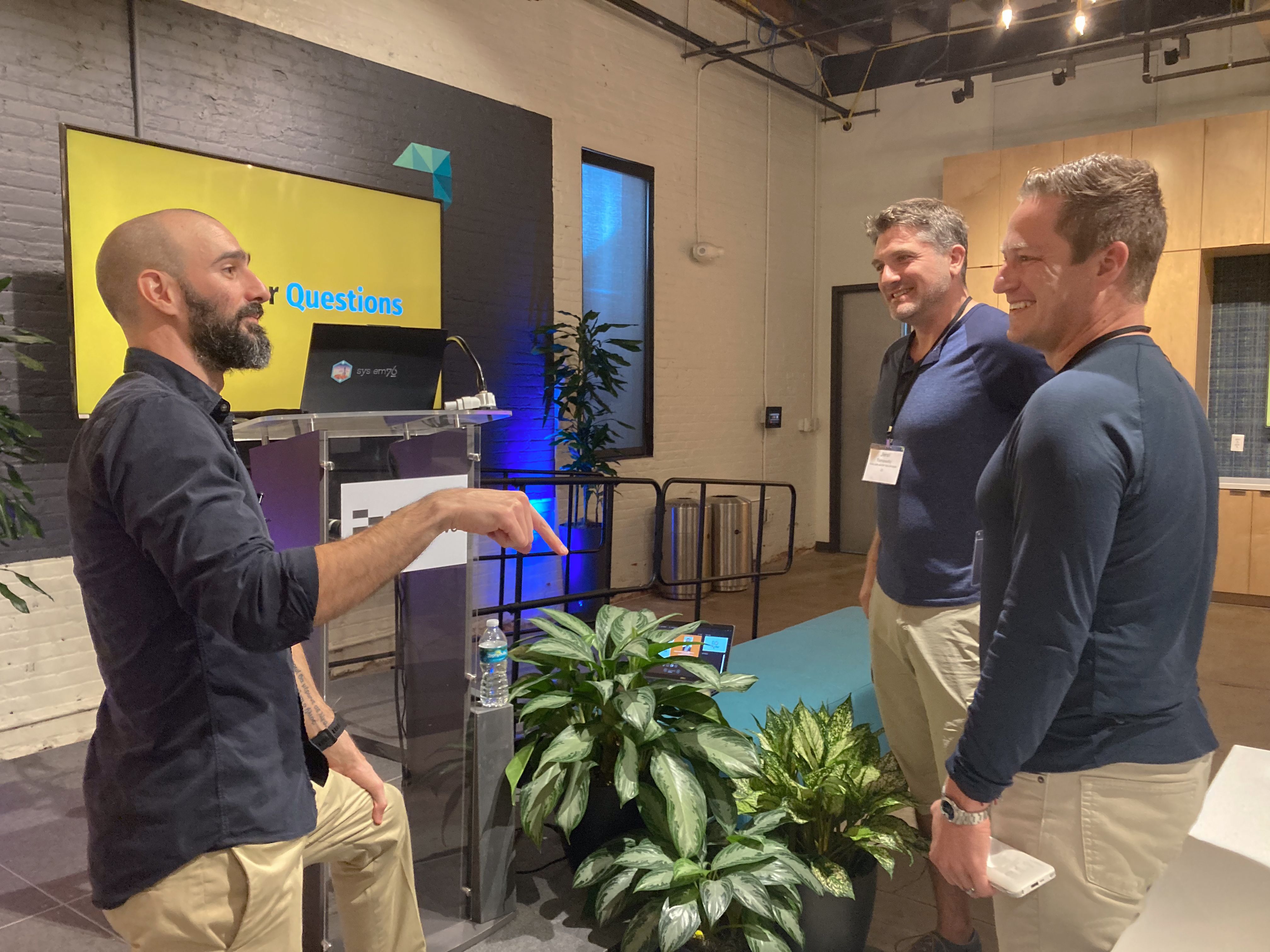
That’s a pivotal line from Arthur Miller’s Death of a Salesman. By coincidence, it was also the theme of a recent IB workshop: How to Pay Attention. And I was so pleased to be one of the presenters, along with Sharon de Korte.
How to Pay Attention was a workshop based on a combination critical thinking experiential and improv comedy exercises. It started with what was a decidedly trick question. Just moments after we called the workshop to order, a women walked in, asked a question, came toward the front of the room and asked the question again. Then left. We asked the participants to write down everything they remembered about the woman — clothes, hairstyle, what she was carrying, and the like. It was no surprise that so many of the blanks that needed to be filled in were wrong, and had been filled in by what the brain thought should be there. The participants thought we had tricked them – simply by not telling them that they needed to pay attention or what they should pay attention to. But isn’t that what so often happens in life? So it turns out not many actually paid close attention, which brought us to our first points of discussion: What’s important to pay attention to? How do we decide what’s important?
After some discussion the conclusion was you really don’t know what’s important until you need it. So how do you pay close attention to conversations, your surroundings to almost anything without having your mind explode? In just a few exercises, we gained some tools and insights into how to better pay attention and still keep your sanity.
Yes, And… We tend to think with our egos and not pay attention to what others are saying.
For example, you can have a conversation where someone says, “That program is too expensive.” You’d normally answer, “Yeah but it’s not.” And they’d say, “Yeah but it is.” Yeah, but it’s not” And on and on getting nowhere except pissing off your potential client. Now take that same conversation and substitute “and” for “but”. Yes, and… (You don’t have to actually say, “Yes, and” just think it). “Yes, and I see your point. Let me show you how much you’re getting for your money.” It’s a way to keep the conversation going. And the longer you can keep it going, the better your chance for a positive outcome. It’s a simple, powerful premise that by just substituting the word “and” for the word “but” you can pay better attention to what’s going on and acknowledge the other person’s opinion (even though you think it sucks). Here are some of the insights by some of the participants:
Watch and Learn Pay attention even when not a word is spoken: Non-verbal communication. Participants were asked to construct an environment using only one repetitive motion. By paying attention the movement, each person could add to the scene by performing a complimentary movement. The challenge came in the form of interpreting what that first physical motion was by paying close attention. Here are some thoughts:
So what did participants learn about paying attention? Paying closer attention is rewarding in its own right because you become more engaged with others and the world around you. And it helps you challenge your own assumptions and opens you to more possibilities and new solutions.
One exercise to try on your own: On your commute to work each day focus on a different object – doorways, trashcans, what people wear (e.g., shoes, watches, coats). It’s a great way to practice paying attention and keep your mind focused and fresh.
So pay attention. Because paying attention will pay you back.
Charlie Allenson is an Adaptive Thinking Coach with Improving with Improv
| See full post and discussion | Posted: 1 month ago |
Apples or Oranges? Solve it with Janusian Thinking!
By Remo Nuzzolese
Janus was the first God in ancient Rome, worshipped hundreds of years before Christianity, he was probably the most important of all deities that populated the roman Pantheon. Janus, or Ianus in latin, was The Creator, God of beginnings and transitions, he presided doors, bridges, new enterprises and he is still giving his name to the first month of the year, January. He embodied elements of change and movement and because these are bidirectional, the God was symbolized with a two-faced head with the two faces looking at opposite directions, able to oversee past and future, left and right, in and out, two different states at the same time.
From here, Janusian Thinking, which is the ability to integrate conflicting elements with a unifying thought giving birth to a new idea that is coherent with the original elements and wider than them.
Many great thinkers in history have proven to – consciously or not – think and create in a Janusian way in the fields of science, politics and the arts: Einstein’s relativity theory, Louis Pasteur’s vaccine, Escher’s paradoxical images and the Mona Lisa’s enigmatic smile are just a few well known examples: a falling object can be perceived as steady, a poison can be its own remedy, a stream of water that falls as it ascends a tower, and so on…
Even easier to recognize it in some popular commercials: “Tough on Dirt - Gentle on Fabrics (Whirlpool Washers)”, “Bet You Can’t Say No to Yes (Dannon Yogurt)” and “Devilishly Good Taste, 90 Saintly Calories (Baskin Robbins Ice Cream).
Religions and spirituality are full of examples of opposing coexisting forces: God and Evil, Nirvana and Samsara and then we have this beautiful symbol, the Tao that integrates Ying and Yang, opposite energies functioning simultaneously as a unified larger principle.
So, how do we relate Janusian thinking to creativity and problem solving? We already know that creativity is also about connecting elements that are distant, putting things together in a new way to develop an original product. Now, imagine how much stronger and radical the answer to a problem would be if it could solve the original problem and its opposite. Janusian thinking is about increasing the complexity of a situation and use it to find more opportunities, is about thinking holistically in terms of AND rather than EITHER-OR without creating a separation between elements that are really not apart and refusing false trade-off between factors that can be integrated in one solution.
Next time you are facing a difficult problem that presents conflicting elements, imagine which are the commonalities, in which wider frame can you include both elements? It’s like being able to choose apples, oranges and the basket too.
These are some of the authors that I researched to write this post; you can easily Google them to dive deep in their interesting literature:
| See full post and discussion | Posted: 2 months ago |
Building a climate for creativity takes 360 degree focus.
By Sharon de Korte
Creativity became a key development focus area for businesses ever since the 2010 IBM study. The study among over 1,500 CEOs across 60 countries and 33 industries found that creativity is considered the most important leadership quality for business success. However, for an organization to be creative, it needs not only creative leaders, it also requires an organizational climate that fosters creativity.
So why are leaders saying that creativity is so important?
As Gerard Puccio, chair of the International Center for Studies in Creativity, said at TEDx Gramercy last December, “because things change, we have to try new things.” Between globalization and the rapid pace of technological change, organizations need to do things differently.
Rita McGrath, in her forthcoming book The End of Competitive Advantage, posits that the new path to business success is quickly grasping short-term opportunities. She believes that it is irresponsible for an executive not to make innovation a strategic priority and ensure there is investment for it.
How to encourage organizational creativity?
The best way to prioritize innovation and encourage doing new things is to have a climate that is open to creative thinking. (To clarify, organizational climate is not to be confused with corporate culture. Organizational climate is the employee perceptions that influence and characterize life in the organization, whereas culture describes corporate beliefs and values.) In addition to communicating the desire for innovation, organizations need to create a climate conducive to fostering the creative thinking that is necessary to power innovation.
The benefit of having a climate conducive to creative thinking is that it not only enables innovation, it also increase employees’ productivity, job satisfaction, and well-being.
What is the right climate for organizational creativity to grow?
Creativity is like a plant; it needs the right environment to grow. We know that plants need the right temperature, water, light, oxygen and nutrients. With creativity, however, it’s not that simple. To cultivate the right climate for creativity to flourish, the organization needs to have a clear purpose, an independent and collaborative process, and people who constructively work together.
Purpose – In order to inspire and engage employees, organizations first need to clearly communicate their purpose and set clear achievement goals. When employees understand the larger purpose of the organization, they are better able to see the value they provide to the organization. When employees believe and accept the organizations’ challenges as their own, they will be inspired to put in the effort to help achieve success. The clearer the organizational goals, the more likely employees will find meaning in their work, which in turn leads to being more personally challenged and more dedicated and committed to the outcome. This personalization of the larger organizational purpose challenges employees and ignites their personal creativity.
Process – For creativity to be maximized, a balance of the employees’ personal independence and team collaboration is needed. Allowing employees the freedom to take initiative along with the time to have and build on ideas is important to fostering a creative climate. It is also necessary for managers to support new ideas by paying attention and encouraging alternatives. Managers also need to have tolerance for the uncertainty inherent in risk taking.
For employees to feel a sense of independence in their work, they need to be encouraged to explore new ways of doing things to overcome challenges to achieving the organizational purpose. By engaging curious thinking, employees can delve deeply and get at the root cause of a challenge. Using a ‘why chain’ discussion to enrich understanding. Take each aspect of the situation and ask why is that happening and then why is that happening. This gets to the root cause of the problem. After crafting some ideas of what needs to be done, asking a ‘what’s stopping us chain’. These two tools will jumpstart the problem solving thinking.
Open, honest discussion of planning such as described should be a standard part of meetings. When a diversity of perspectives are encouraged in the development of new approaches to situations, employees’ creativity is awakened and new possibilities can arise.
Encouraging new thinking isn’t enough. Employees should be allowed to take advantage of opportunities - even potentially risky ones, without fear. It can be difficult for managers to be comfortable with uncertainty inherent in allowing employees to try new things. Experimenting on a small scale will encourage employees. Managers should quickly respond to decisions and new ideas with positive and constructive feedback.
Mistakes are critical for learning. Rather than punishing risk taking, which fosters doing the same old same old, have ‘no blame’ debriefing sessions where everyone involved shares experiences. Probing fully around the following three questions: What happened? Why did it happen? What did we learn? to fully explore the situation. Then develop new solutions based on the new learning.
To balance personal independence and team collaboration, when I managed a team, we had quarterly strategic planning meetings. Each meeting started with a creative exercise to get our minds out of the everyday challenge of our email and most urgent problems. After that we had an open dialog about what’s working well and what do we or our clients wished was different. We went through each one diagnosing the situation (using why? and what’s stopping us? chains) and setting up action steps to overcome the issue. Each person volunteered to lead different initiatives. In order to be sure that we implemented these (or improved ideas), we also added them to our regular staff meetings.
It is critical to balance the desire for big wins with the value of small failures. I like to say, ‘fail small to win big.’ Small experiments are learning opportunities (aka mistakes) can build momentum to achieving the big wins.
People – The best intentions of having a climate that engages employees in the creative process will only be as successful as the people involved. To give employees the courage to pursue possibilities, employees must feel emotionally safe. While emotional safety is generally important in the workplace, it is paramount for creativity. The fundamental principles for creative interaction are trust/openness and lack of conflict.
When asking people to be creative, we are encouraging them to use their imagination and do things differently. Using our imagination is likely to make people to feel vulnerable. Each idea should be treated as a gift – with acknowledgement and appreciation for what they can bring in a positive and productive way.
Another aspect is that employees need to be willing to give their ideas and make suggestions without conflict. One simple way to do this is to not say the word ‘but.’ Every mention of the word ‘but’ in creative discussions, not only kills that idea but often limits the persons desire to participate. Have a conversation with someone where every time they say something you say ‘yes, but’ and then try the same exact conversation and say ‘yes, and’. It is a profound difference. In one they don’t want to speak and in the other they feel their contribution was valuable and are energized and having fun.
Environment – Even with all the above an organization may not be reaching its full creative potential. The last critical component for creative flourishing is that the energy needs to be dynamic, lively with a sense of playfulness and humor. Organizations are like animals – they can either energized or sleepy and tired. The environment should engage people’s curiosity through the acceptance of experimentation and new things happening. A relaxed atmosphere where people are having fun and engaged brings out the creative sparks.
One challenge in establishing a creative environment today is that teams are increasingly more virtual. While there are an increasing number of online collaboration tools, these are often enablers but not encouragers. One way to overcome this challenge is to build playfulness into the tool – the gamification of collaboration. Rather than just installing the software and hoping that employees use it, make it fun and engaging with challenges, points, rewards etc.
How is the creative climate of your organization or group? Here are some questions to ask yourself about the organization or group you are part of. A low score is holding back creativity.
Purpose:
Process:
People:
Environment:
Sources:
| See full post and discussion | Posted: 3 months ago |
The Talent Development team at a major engineering firm needed to create a coherent innovation curriculum across all levels of leadership in the organization. The result was the design and development of learning objectives and curriculum across five talent pools with common themes and core messages on driving organizational innovation by focusing on individuals, climate, operations and strategy.
| See full post and discussion | Posted: 4 months ago |
Brainwriting
A Collaboration Tool for Introverts
By Costa Michailidis
“Innovation is for a few ‘special’ people.”
“Creativity is innate. You either have it, or you don’t!”
Part of the work we do at Innovation Bound is bust myths like these, and one of our favorite myths, that has percolated more recently, is the notion that collaboration is bad for innovation, and that true breakthroughs are made solo. Why would the individual, group, or crowd be “the best medium for innovation?” Powerful innovations have resulted from all three of these, and context (the challenge at hand, available resources, et cetera) clearly plays a critical role. We dug a little deeper and came to an interesting challenge: How can groups have effective fair collaborations that are not dominated by strong personalities and extroverted behavior?
A Quiet Idea Generation Tool
The solution we’ve found most effective is an exercise called Brainwriting. It is a powerful way to quickly generate and build on one another’s ideas. Here’s how it’s done:
If you need more ideas, you can use larger grids. Participants can build on each others ideas very directly, or just be “inspired by” the other ideas on the sheet. You can also do the exact same exercise on a Google Spreadsheet live online from different geographical locations.
Doing the work that we do has shown us time and time again that there is always a way to overcome obstacles, to tackle challenges, and to reach our goals. Don’t let common myths get in your way.
Sources:
| See full post and discussion | Posted: 4 months ago |